VIN vs. Engine Number: What's the Difference?
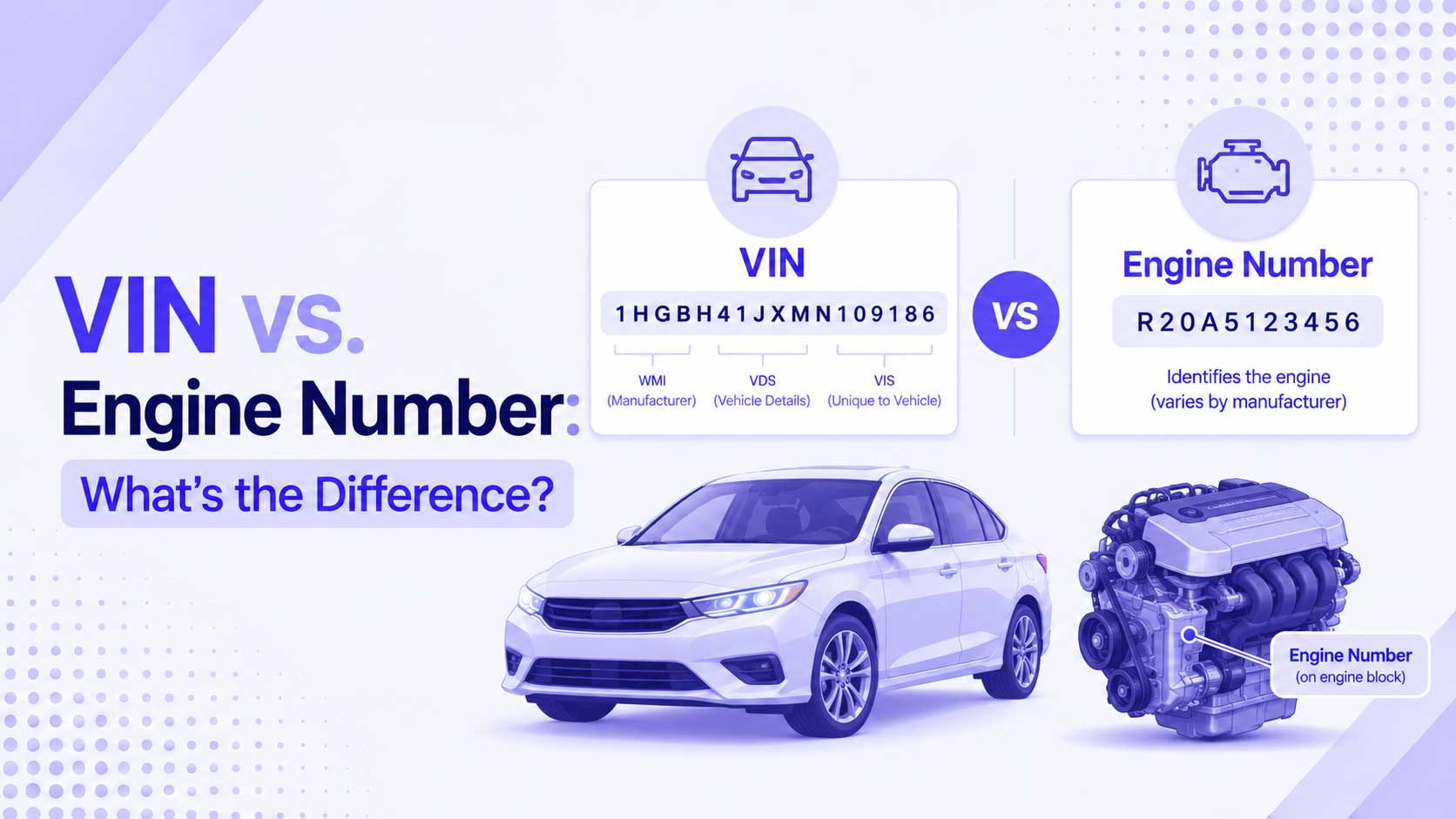
People often use “VIN” and “engine number” as if they mean the same thing. They do not. One identifies the whole vehicle, the other identifies just the engine, and confusing them leads to wrong parts orders, failed registrations, and bad used-car checks. Here is what each number is, where to find it, and when you need which.
The Short Answer
A VIN identifies the entire vehicle as a unit. An engine number identifies the engine as a component. The VIN stays with the car for life; the engine number stays with that specific engine, which can, in theory, be moved to another car.
| Feature | VIN | Engine number |
|---|---|---|
| Identifies | The whole vehicle | Just the engine |
| Length | Always 17 characters | Varies by maker |
| Standardized | Yes (ISO 3779) | No, maker-specific |
| Where | Dashboard, door jamb, title | Stamped on the engine block |
| Stays with | The car | The engine |
What the VIN Is
The Vehicle Identification Number is a 17-character code assigned to the vehicle when it is built. It follows a global standard, so every VIN has the same structure: a manufacturer section, a description section, and a unique serial, plus a check digit that verifies the whole thing. It encodes the country of origin, the maker, the model year, the plant, and more.
Because it is standardized, the VIN is what registrations, titles, insurance, and history reports are built around. To see how the 17 characters break down, read how to read a VIN, and to find it on the car, see where to find your VIN.
What the Engine Number Is
The engine number is stamped directly onto the engine block, usually by the manufacturer. It identifies that engine specifically, and its format is not standardized. Different makers use different lengths and layouts, and it often encodes the engine type and a production sequence for that component.
The engine number matters when the engine is the thing in question: ordering internal parts, verifying an engine has not been swapped, or matching an engine to its paperwork in regions that record it. It says nothing about the body, trim, or history of the car as a whole.
Why People Mix Them Up
The confusion comes from a real overlap: the VIN also contains an engine code. Position eight of the VIN is a single character that identifies the engine family the car left the factory with. But that is a code, not the engine’s own stamped number. Position eight tells you “this car came with the 2.0L four-cylinder.” The engine number stamped on the block identifies that individual engine unit.
So the VIN can tell you what kind of engine the car should have. Only the stamped engine number identifies the physical engine sitting in it. If the two disagree, someone may have swapped the engine.
Which One Do You Need?
It depends on the task:
- Registering, insuring, or buying a car? Use the VIN. It is the legal identity of the vehicle.
- Running a history or recall check? Use the VIN. Reports are keyed to it.
- Ordering engine internals, or checking for an engine swap? You may need the engine number stamped on the block, and the VIN’s position-eight engine code to compare.
- Confirming a car is what the listing claims? Start with the VIN, then match the engine.
For most buyers and owners, the VIN is the number that matters. The engine number is a specialist detail that comes up mainly in repairs, rebuilds, and some import or registration cases. Motorcycles are a common exception, where the engine number is recorded more often. See how to decode a motorcycle VIN for how that works.
Check Your VIN First
Whatever the task, the VIN is the anchor. Before you trust it, confirm it is genuine: paste it into our VIN Validator to check the length, characters, and check digit, or use the VIN Decoder to read the make, country, year, and the position-eight engine code. Once the VIN checks out, you know which vehicle you are dealing with, and you can match the engine number from there.
Keep Reading
- Where to Find Your VIN: Every Location on Your Vehicle
- How to Read a VIN: What All 17 Characters Mean
- How to Decode a Motorcycle VIN
- How to Tell What Engine a Car Has From the VIN
Free VIN tools: VIN Generator · VIN Decoder · VIN Validator · Bulk Generator · QR Code Generator · Visualizer