How to Read a UK Number Plate: Area Letters and Age Codes
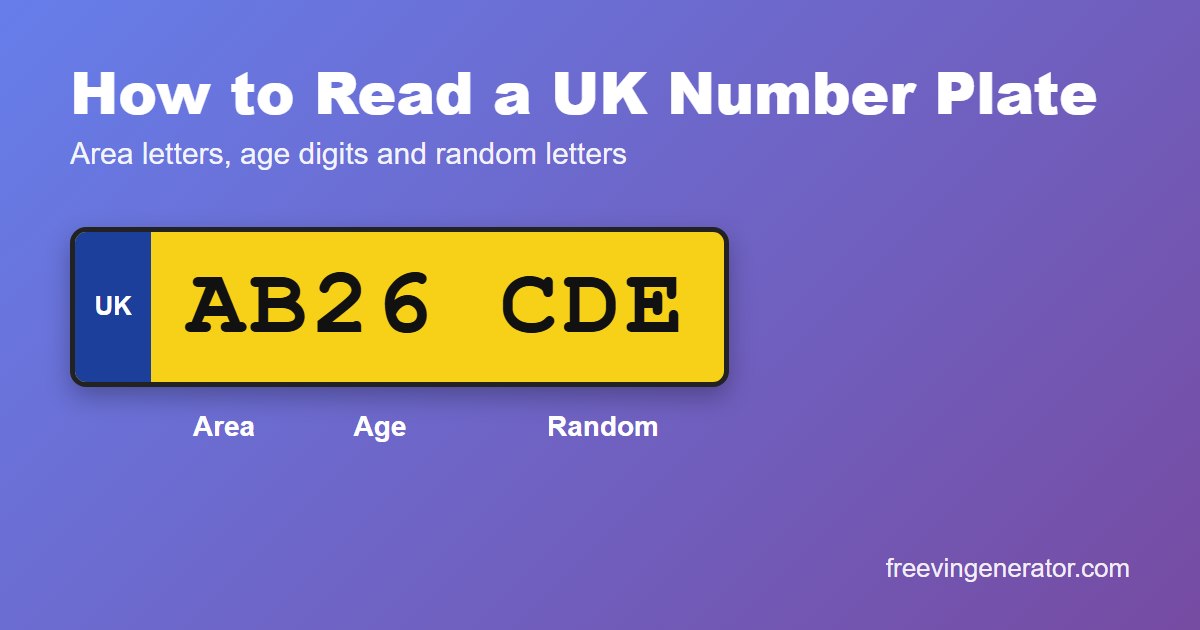
A UK number plate looks like a random scramble, but seven characters carry three separate pieces of information. Once you know the pattern, you can tell roughly where a car was first registered and when, just by looking at the back of it. You can do it in a few seconds.
Take AB26 CDE. The plate has three parts.
| Part | Example | What it is |
|---|---|---|
| Area letters | AB |
Where the car was first registered |
| Age digits | 26 |
When it was first registered |
| Random letters | CDE |
Picked at random, so each plate is unique |
This is the current style, used since 1 September 2001. It is set out in the DVLA leaflet INF104, which is the source for everything on this page about how the format works.
The First Two Letters: Where the Car Was Registered
The first letter points to a region. The second letter narrows it down to one of the DVLA’s local offices. The leaflet lists the regions like this:
| Letter | Region | Letter | Region |
|---|---|---|---|
| A | Anglia | M | Manchester and Merseyside |
| B | Birmingham | N | North |
| C | Cymru (Wales) | O | Oxford |
| D | Deeside to Shrewsbury | P | Preston |
| E | Essex | R | Reading |
| F | Forest and Fens | S | Scotland |
| G | Garden of England | V | Severn Valley |
| H | Hampshire and Dorset | W | West of England |
| K | Borehamwood and Northampton | Y | Yorkshire |
| L | London |
So a plate starting with L was first registered in London, and one starting with S in Scotland. The letters I, Q and Z are never used in the area code.
There is one catch. The area tells you where the car was first registered, not where it lives now. A car sold from Leeds to Cornwall keeps its Y plate. It also means a personalised plate can show any area at all.
The Two Digits: How Old the Car Is
The two digits are the age identifier. They change twice a year, on 1 March and 1 September.
- March to August: the last two digits of the year. So
26means March 2026. - September to February: the year plus 50. So
76means September 2026.
That is why you see two plates for every year, such as 25 and 75 for 2025.
| Age digits | Registered |
|---|---|
| 24 | March to August 2024 |
| 74 | September 2024 to February 2025 |
| 25 | March to August 2025 |
| 75 | September 2025 to February 2026 |
| 26 | March to August 2026 |
| 76 | September 2026 to February 2027 |
| 27 | From March 2027 |
The system is not new, only the layout is. Age letters were first used on cars in 1963, so a buyer could judge a car’s age at a glance. The version with two digits replaced them in 2001.
A quick rule: if the number is over 50, subtract 50 to get the year. A plate with 68 is September 2018 to February 2019.
The Last Three Letters: Pure Chance
The final three letters are chosen at random. They mean nothing, and they exist so that every plate is unique. The letters I and Q are normally left out. This is widely reported, though the DVLA leaflet does not say it outright. Z is allowed here, even though it never appears in the area code.
Front and Rear Plates
The rear plate has black characters on a yellow reflective background. The front plate is white.
Older Plates
Two older layouts still turn up on the road:
- Prefix, 1983 to 2001: a letter, up to three digits, then three letters, such as
A123 BCD. The first letter is the year. - Suffix, 1963 to 1983: three letters, up to three digits, then a letter, such as
ABC 123A.
Northern Ireland uses its own format, letters followed by up to four digits, such as ABZ 1234, so the rules above do not apply there.
What a Plate Does Not Tell You
A plate gives you a rough area and age. It tells you nothing about the owner, the car’s model or its history. A plate can also be moved from one car to another, and a private number can disguise how old a car is. If you are buying a used car, do not trust the plate alone. Check the VIN against the car’s paperwork, and read how to find the chassis number in the UK.
Make Your Own Sample Plates
If you need UK plates for testing an app or a design, the license plate generator makes random ones in the current format. It follows the DVLA rules above and never uses an age code that has not been issued yet. They are samples, not real registrations. Never put one on a vehicle.
Keep Reading
- VIN vs. License Plate vs. Registration: The Difference
- How to Find the Chassis Number in the UK
- How to Read a VIN: What All 17 Characters Mean
- VIN Names Around the World
Free tools: License Plate Generator · VIN Generator · VIN Decoder · VIN Validator