VIN vs. License Plate vs. Registration: The Difference
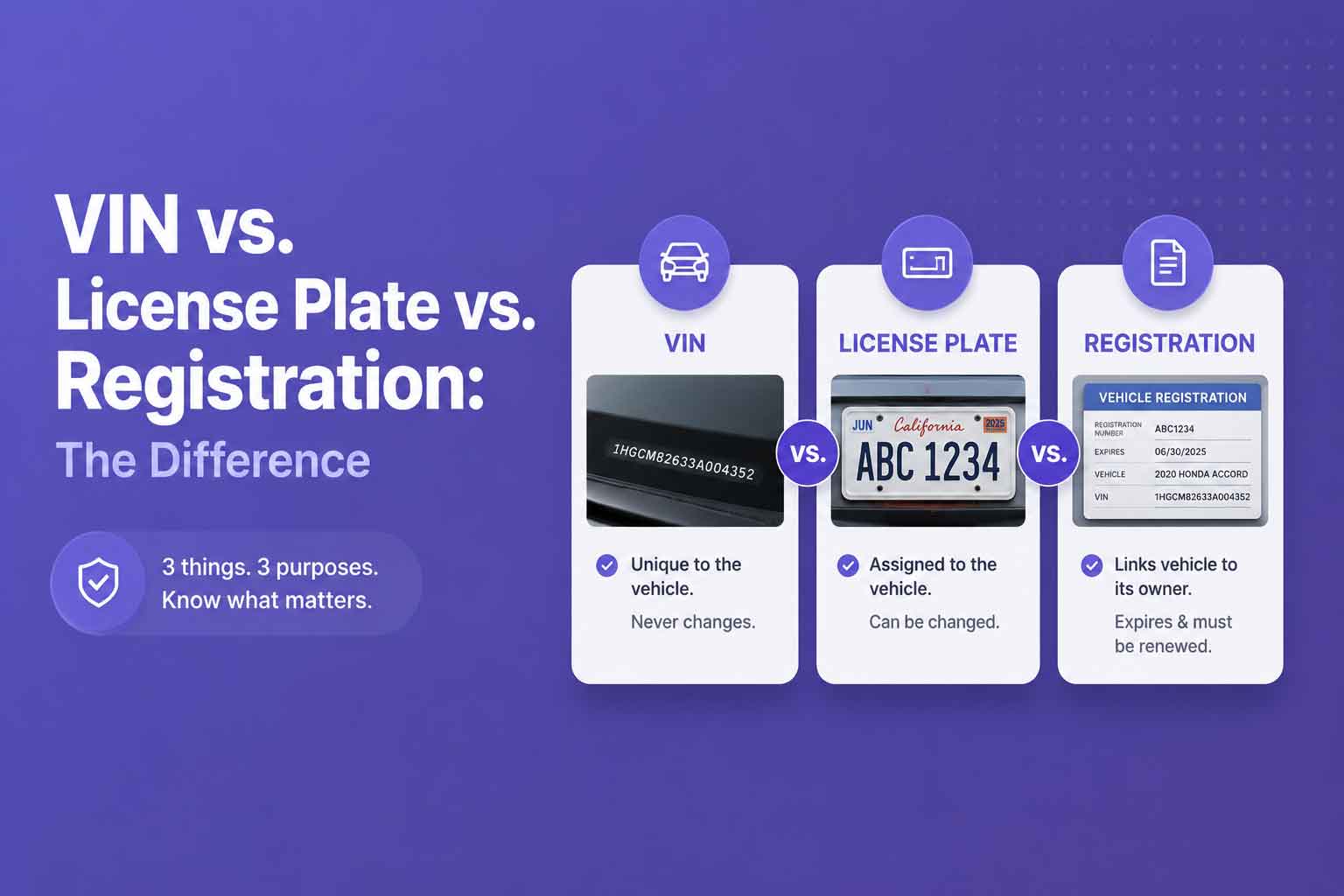
Three numbers follow a car around, and people mix them up all the time. The VIN, the license plate, and the registration number sound like they do the same job. They do not. One never changes, one changes often, and one is really a document that ties the other two to an owner. Knowing which is which saves you from filing the wrong number on the wrong form.
The Short Version
- VIN: the car’s permanent identity, stamped at the factory, fixed for life.
- License plate: a public tag the government assigns, easy to change.
- Registration: the paperwork proving a specific owner registered the car, renewed on a schedule.
Here is how they compare at a glance:
| VIN | License plate | Registration | |
|---|---|---|---|
| Identifies | The vehicle itself | The car in public/traffic | The owner-vehicle link |
| Assigned by | The manufacturer | The government (DMV/DVLA) | The government |
| Changes? | Never | Often | Renewed periodically |
| Where it lives | Stamped on the car | Bolted to the bumper | On a document |
| Length/format | 17 characters | Varies by region | Varies by region |
The VIN: Permanent Identity
The VIN is built into the car. The manufacturer stamps this 17-character code onto the dashboard, the door jamb, and the frame, and it stays with the vehicle from the factory to the scrapyard. Sell the car, move states, swap the plates, and the VIN does not budge.
Because it never changes, the VIN is what recalls, insurance, title records, and history reports are keyed to. If you want to know what a car actually is, you decode the VIN. Our guide on how to read a VIN breaks down what each character means, and the VIN Decoder reads the maker, country, and year straight from the number.
The License Plate: A Changeable Tag
The license plate is the number bolted to the bumper. A government office issues it so police, cameras, and toll systems can identify the car on the road. Unlike the VIN, the plate is easy to change and often does.
A plate can move to a new owner, get replaced when you switch states or countries, transfer to a different car in some regions, or change to a personalized version. The plate identifies the car in public, but it is not a reliable long-term ID, because it is designed to be reassigned.
The Registration: The Owner’s Paperwork
The registration is not really a number on the car at all. It is a document, and the registration number identifies that record. It proves that a specific person registered the vehicle with the authorities, paid the fees, and is allowed to drive it on public roads.
A registration ties the two other identifiers together. It lists the VIN, the plate, and the owner, and it expires on a schedule, which is why you renew it. Let it lapse and the car is still the same car with the same VIN, but it is no longer legally registered to drive.
When You Need Which
- Buying, insuring, or checking history: use the VIN. It is the one that never lies and never changes.
- Reporting a car on the road, parking, or tolls: the license plate does that job.
- Proving you own and can drive the car: the registration document.
Mixing them up causes real headaches. Put a plate number where a VIN belongs on an insurance form, and nothing matches. When a task asks for the vehicle’s identity, it almost always wants the VIN.
The Takeaway
Think of it this way. The VIN is who the car is. The plate is what the car is called in public today. The registration is the paperwork that says who the car belongs to right now. One is permanent, one is swappable, one is a receipt. Keep them straight and every form gets easier.
Keep Reading
- How to Read a VIN: What All 17 Characters Mean
- Where to Find Your VIN: Every Location on Your Vehicle
- What a VIN Tells You: Decoding Make, Model, and Year
- How to Check If a Car Is Stolen Using the VIN
Free VIN tools: VIN Generator · VIN Decoder · VIN Validator · Bulk Generator · QR Code Generator · Visualizer