US License Plate Formats by State: How They Work [2026]
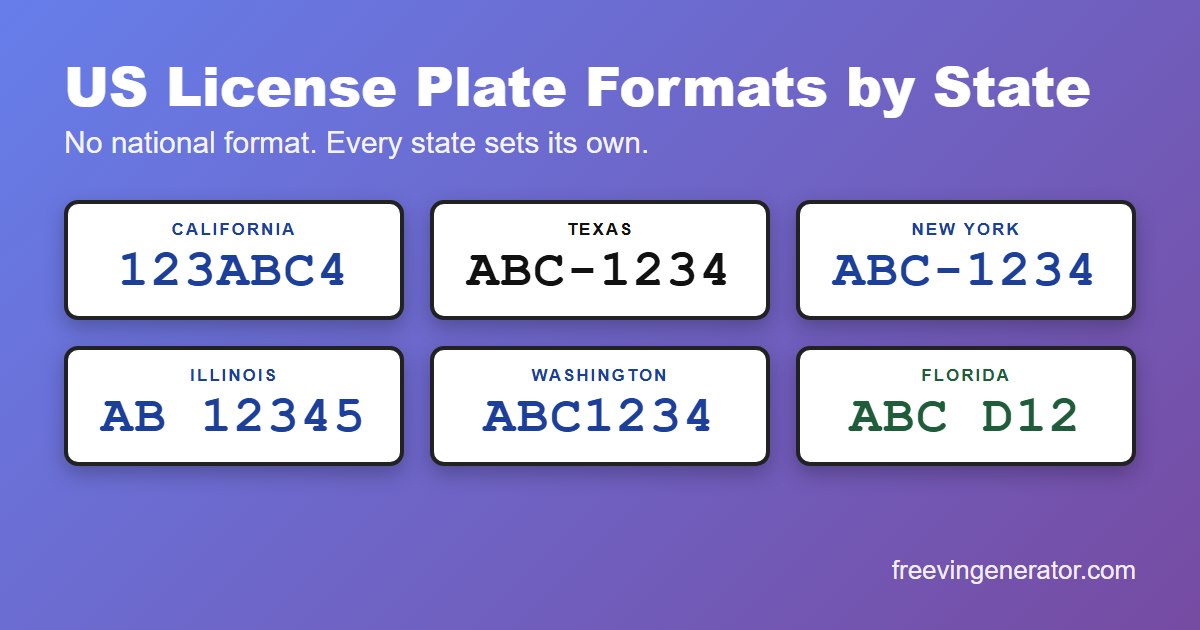
Ask what a US license plate looks like and the honest answer is: it depends on the state. There is no national format. Each state decides how many characters a plate has, which ones are letters, and what the design looks like. A plate from Texas and a plate from California follow different rules, and neither tells you much about the car.
That makes plates awkward for anyone who builds software that has to accept them, and a little confusing for everyone else. Here is how the formats work, with real examples.
The Common Patterns
Most standard plates use six or seven characters. Three layouts show up again and again:
- Three letters, then three or four digits. Examples are
ABC-1234andABC 123. - Digits at the start or the end. Some states put a digit first, such as
1ABC234. - A mix of both. A few states mix letters and digits in a fixed pattern, such as
A12-BCDin New Jersey.
Many states leave out letters that look like digits, such as I, O and Q, so a plate is easier to read. The exact list is different from state to state.
Formats in Some Popular States
This table shows the standard passenger plate in a sample of states. States change their designs often, so check your own state’s motor vehicle office if you need the format to be exact.
| State | Format | Notes |
|---|---|---|
| California | 123ABC4 |
New format from early 2026. The older one was 1ABC234. |
| New York | ABC-1234 |
Excelsior design, 2020. |
| Texas | ABC-1234 |
Texas Classic design, 2012. |
| Pennsylvania | ABC-1234 |
Liberty Bell design is the standard plate from mid-2025. |
| Florida | ABC D12 |
Several series are issued at the same time. |
| Illinois | AB 12345 |
Two letters and up to five digits. |
| Ohio | ABC 1234 |
Sunrise design, 2021. |
| Michigan | ABC 1234 |
Pure Michigan design, 2013. |
| Virginia | ABC-1234 |
Issued since 2014. |
| Washington | ABC1234 |
Three letters and four digits with no space. |
| Delaware | 123456 |
Only digits, one to six of them. |
You can try each of these in the license plate generator, which covers 40 states and Washington, DC. California, New York, Texas and Pennsylvania are confirmed from official sources. The rest follow the best sources we found, and the tool says so.
Plates That Contain a Code
Most plates are just a serial. A few states build a code into the number:
- County numbers. Montana and several other states start the plate with a number for the county where the car was registered. A Montana plate looks like
1-AB2345. - Hawaii. The first letter is tied to the county.
None of these tell you who owns the car. They only hint at where it was registered.
One Plate or Two
Some states require a plate on the front and the back. Others, such as Florida, issue only a rear plate. California requires two. If you are running a camera or a parking system that reads plates, this matters, because a car coming toward you may have no plate at all in a one-plate state.
What a Plate Does Not Tell You
A plate is a label for a registration. It does not tell you the make, the model, the year or the owner, and it can be swapped between cars. The thing that follows a car for life is the VIN. If you want to know what a car really is, read the VIN and not the plate. The difference is explained in VIN vs. License Plate vs. Registration, and How to Read a VIN shows what its 17 characters mean.
Testing With Sample Plates
If you build a form that takes a plate number, test more than one state. A pattern that works for ABC-1234 fails for 123ABC4 and for AB 12345. Allow letters and digits in any order, strip spaces and hyphens before you compare, and do not assume a fixed length. The generator gives you random sample plates in each state’s layout, with the reminder that they are samples, not real registrations. Never put one on a vehicle.
Keep Reading
- How to Read a UK Number Plate: Area Letters and Age Codes
- VIN vs. License Plate vs. Registration: The Difference
- How to Generate Test VINs for Software Testing
- How to Read a VIN: What All 17 Characters Mean
Free tools: License Plate Generator · VIN Generator · VIN Decoder · VIN Validator