VIN QR Code: Safe or Fake? 5 Checks Before You Trust It [2026]
Last updated: October 29, 2026
You are about to buy a used car. The seller points to a sticker with a QR code and says, “Scan it. The whole history is in there.”
It feels official. It looks modern. And it tells you almost nothing.
A QR code is just a way to store text. Anyone can make one for any VIN, in about ten seconds, for any car. So the code is not proof of anything. What matters is what is inside it, and whether that matches the car in front of you.
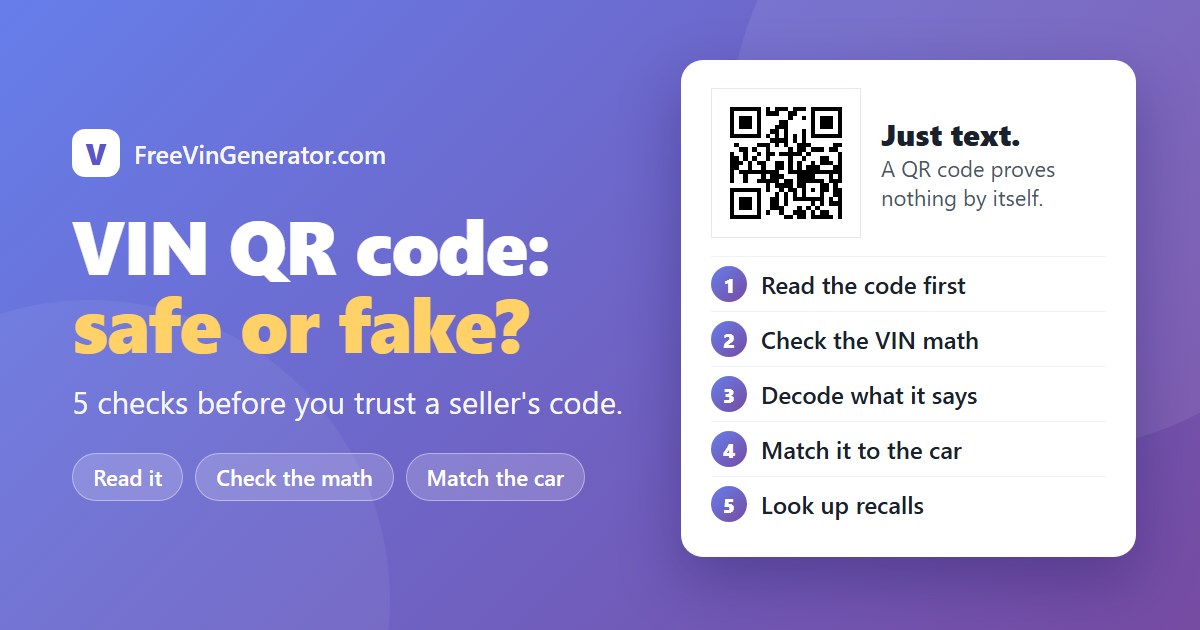
Here are five checks that take a few minutes and catch the most common problems.
What is actually inside a VIN QR code?
Usually one of two things: the 17 characters of the VIN, or a web link.
The QR codes we make with our VIN QR tool hold only the VIN. In our own tests, we generated codes for several VINs at different sizes and decoded every one. Each one gave back exactly the 17 characters and nothing else. You can read how we ran those tests in How Small Can a VIN QR Code or Barcode Be and Still Scan?
A code from someone else can hold anything, including a link you did not expect.
Quick Tip: Treat a QR code like a text message from a stranger. Read it first. Do not act on it until you know what it says.
Can a QR code prove a car is real?
No. A QR code can only repeat what someone typed into it. If a seller types a fake VIN, the code shows a fake VIN. If a seller copies the VIN of a real car onto a different car, the code shows a perfectly real VIN.
Warning: A “clean history” claim that lives only inside a QR code is just the seller talking. Check it somewhere you control.
Check 1: Read the code before you open anything
Most phone cameras show what is inside a QR code at the top of the screen before they open it. Look at that preview.
| What the preview shows | What it means | What to do |
|---|---|---|
| 17 letters and numbers | A plain VIN, no link | Go to check 2 |
| A web address you do not know | The code sends you to a page the seller controls | Do not open it. Type the VIN into a trusted tool yourself |
| A web address asking you to log in or pay | A common trick to collect your details | Close it and walk away |
| Nothing readable | The code may be damaged or fake | Ask for the VIN in plain text |
If the code is a link, the VIN is not in the code at all. Ask the seller for the VIN written out, then check it yourself.
Check 2: Does the VIN pass the math?
Every VIN made for North America has a built-in check digit. It is the ninth character. It comes from a small calculation on the other 16 characters. If someone makes a typo or invents a VIN, the math usually fails.
Try it with a sample VIN:
4T1B61BKXNU123456passes. The ninth character is X, and the math gives X.4T1B61BK1NU123456fails. The ninth character is 1, but the math gives X.
Paste the seller’s VIN into the VIN Validator. It checks the length, the letters, and the check digit in one second. If you want to see the steps, the Check Digit Calculator shows each one.
Quick Tip: Cars built for other regions may not use a check digit. A failed check is a reason to look closer, not proof of fraud on its own.
Check 3: What does the VIN say the car is?
A VIN carries real facts: who built the car, the model year, and the plant. Decode it and compare the answer with the car you are looking at.
Take the passing sample above. Our VIN Decoder reads it as a 2022 model with a Toyota maker code. The NHTSA database, the US government’s public vehicle data, says it is a 2022 Toyota Camry built in Georgetown, Kentucky.
Now imagine the seller’s car is a 2018 SUV from a different brand. The VIN and the car do not match. Walk away.
Things to compare:
- The make and model
- The model year
- The body style and engine
- The country or plant, if the car is imported
Check 4: Does the VIN match the car in front of you?
This is the check most people skip. Find the VIN on the car itself and compare every character with the paperwork and the QR code.
You can usually find it in three places: a plate at the base of the windshield on the driver’s side, a label on the driver’s door frame, and the registration papers. Our guide to where to find your VIN shows each spot.
Look at all three. They should say exactly the same thing. Also check that the plate and labels look original: no scratches around the rivets, no glue marks, no mismatched fonts.
Warning: A cloned car carries a real VIN copied from another vehicle, so it passes the math and decodes perfectly. Only a mismatch between the car, the papers, and its history gives it away. Read how VIN cloning scams work before you pay a deposit.
Check 5: Look up recalls and history
A real VIN should have a real record. Run it through the NHTSA recall search at nhtsa.gov/recalls. It is free and shows open safety recalls for that VIN.
Then check whether the car was reported stolen. Our guide on how to check if a car is stolen using the VIN lists the places to look.
A car with no record at all, or a history that does not fit the story, deserves more questions.
When is a VIN QR code actually fine?
For your own use. Workshops, dealers and fleets put VIN QR codes on key tags and files because a phone can read them fast. In that setting you made the code, so you know what is inside it. The risk we described in this article comes from codes made by someone else.
Frequently Asked Questions
Can a VIN QR code be fake?
The code itself is not “real” or “fake.” It is just text. What can be fake is the VIN inside it, or the link it opens. That is why you check the VIN against the math, the NHTSA data, and the car itself.
How do I check a VIN from a QR code?
Scan the code and read the preview. If it shows 17 characters, copy them into the VIN Validator and the VIN Decoder. If it shows a web address, do not open it. Ask the seller for the VIN in plain text.
Is it safe to scan a QR code on a used car?
Scanning is usually fine. The risk is what you do next. Read the preview, do not open unknown links, and never enter personal or payment details on a page a QR code sent you to.
Has a seller ever shown you a VIN code that did not match the car? Tell us what happened on the contact page. Your story could help the next buyer.