How to Check a VIN or Chassis Number in Australia
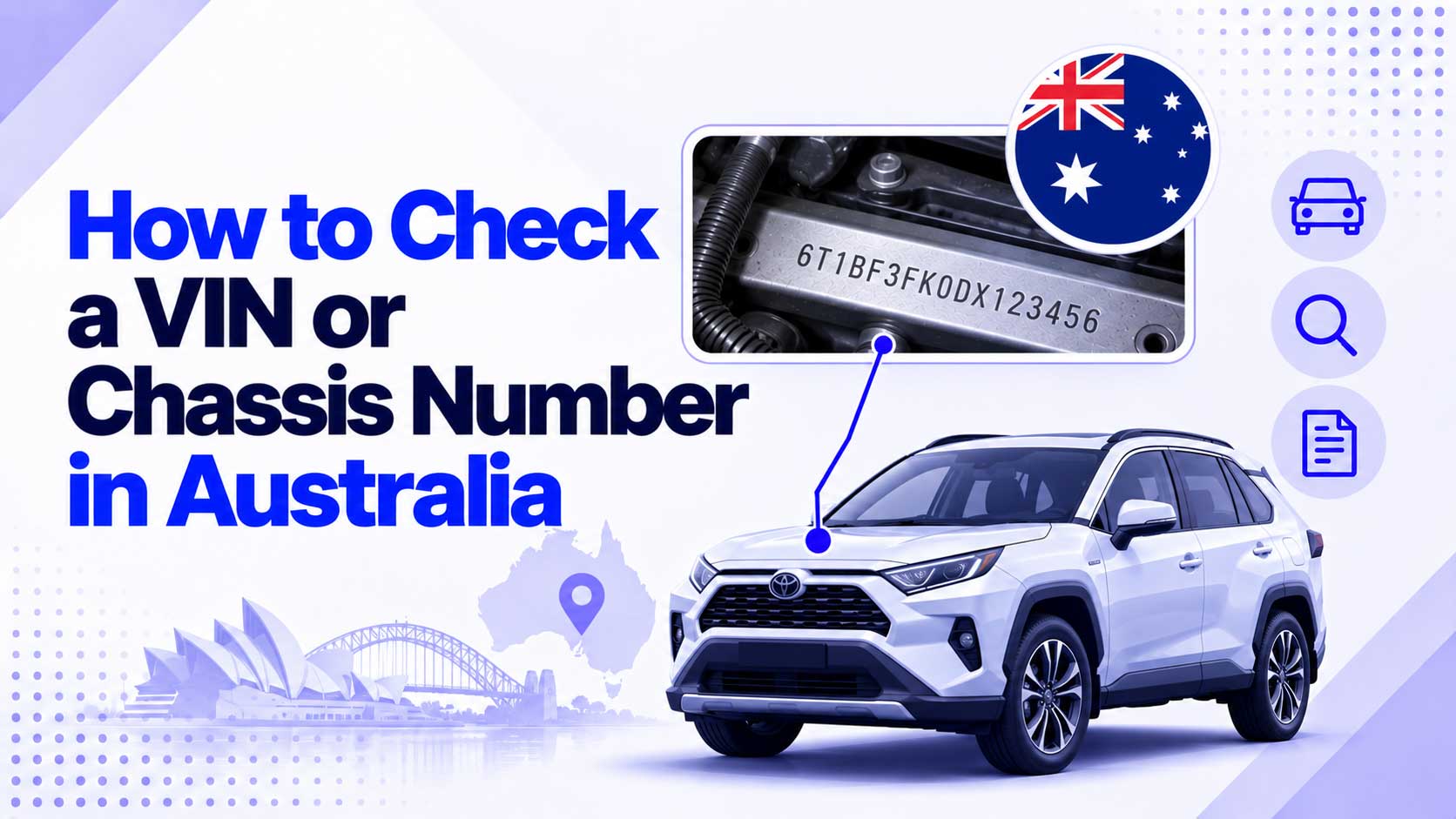
Buying a used car in Australia, the number you need goes by two names. Sellers and older paperwork say “chassis number.” Newer cars and official services say “VIN.” On most cars built in the last few decades, they are the same 17-character code.
What matters more is what you do with it. Here is where to find it, how to read it, and the official check that can save you from buying a car with money still owing on it.
VIN vs Chassis Number in Australia
The 17-character VIN became mandatory for vehicles supplied to the Australian market on 1 January 1989. Anything older usually carries a shorter chassis number stamped on the firewall or a chassis rail, with no check digit and no encoded year or origin.
So “chassis number” can mean either the modern VIN or an older, shorter stamp. If you want to see how other countries use these words, read what a VIN is called around the world. For old cars, our guide to decoding a pre-1981 VIN explains why shorter numbers do not decode the usual way.
Some vehicles that arrive without a 17-character VIN are given one by the federal government, using the prefix 6ZZ. That is a legitimate government-issued number, not a sign of a fake.
Where to Find the VIN or Chassis Number
| Location | What to look for |
|---|---|
| Compliance plate | A plate fixed to the vehicle showing make, model, build date and the VIN or chassis number. Often in the engine bay, on a door pillar or near the passenger-side footwell. |
| Registration papers | Your state or territory registration documents. |
| Body or chassis stamping | A stamped number on the body or frame. |
| Windscreen or door label | A plate or sticker on newer cars. |
The compliance plate is the one to check first. Read the number on the plate, then on any stamping, then on the registration papers. They should all match. Our where to find your VIN guide covers more spots.
Run a PPSR Check
This is the single most useful step. The Personal Property Securities Register (PPSR) is the Australian Government’s register, and its car check searches by VIN or chassis number. It can tell you whether the car has money owing on it, and it may also show whether the car is recorded as stolen or written off.
Two points to keep straight:
- Finance matters. If a car has a security interest registered against it and you buy it, the lender may still have a claim on the car. The PPSR is how you find that out before you pay.
- Write-off and stolen data comes from other databases. That information is supplied through a national exchange system, and it may not always be available or fully up to date. Treat a clear result as a good sign, not a guarantee.
There is a fee for the search, and the price can change, so check the current cost on the official PPSR site. Use the official government site and be careful of third-party sites that charge much more for the same search.
Check the Registration Too
The PPSR check runs on the VIN. Your state or territory road authority runs its own registration check, usually from the number plate. Use both. Confirm the plate, the VIN on the car and the VIN on the papers all point at the same vehicle, and that the seller’s name matches the registered owner.
Read the VIN Itself
A 17-character Australian-market VIN tells you a lot. The first character shows where the car was built: 6 is Australia, J is Japan, W is Germany, and so on. Paste the number into our VIN Decoder to read the country, maker and model year, or see how to read a VIN for what each position means.
Our decoder and validator follow the North American standard. Many imported cars use the check digit differently, so a failed check on a genuine import does not prove a fake. We explain why in what a VIN check digit is.
Warning Signs
- The VIN on the compliance plate does not match the registration papers.
- The plate looks re-riveted, scratched or glued.
- The seller will not let you photograph the number.
- The PPSR shows finance owing that the seller did not mention.
If any of these appear, pause the sale. For the wider set of warning signs, see how VIN cloning scams work and how to check if a car is stolen by VIN.
Keep Reading
- What a VIN Is Called Around the World
- Where to Find Your VIN: Every Location
- How to Check Accident History by VIN
- How to Check If a Car Is Stolen by VIN
Free VIN tools: VIN Generator · VIN Decoder · VIN Validator · Bulk Generator · QR Code Generator · Visualizer